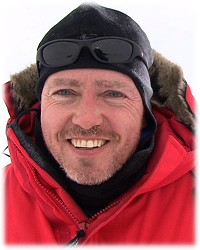
 David Holland David HollandProfessor of Mathematics and Atmosphere-Ocean Science in the Courant Institute of Mathematical Sciences (CIMS) of New York University (NYU). David Holland is an oceanographer who studies the phenomena of the polar oceans and their impacts on global climate, for example, global sea level. He uses numerical models (i.e., atmosphere/sea-ice/ice-shelf/ocean/land) to study the general circulation and inter-annual to longer-timescale variability of the polar oceans and ice. Holland's current research includes the study of the interaction of floating ice shelves with polar ocean waters, the acquisition and implementation of observational data for model improvements, and the study of the teleconnection between polar and temperate/tropical latitudes. In 2007, he placed time-lapse cameras and an automatic weather station on the Jakobshavn Ice Fjord, in Greenland, the fastest-moving glacier in the Arctic. In 2008, working with NASA's Bob Bindschadler, he visited the Pine Island Glacier, in West Antarctica, to plan future research on the fastest-moving glacier in the South. (see Pine Island Glacier Research Expedition). Holland is Professor of Mathematics and Atmosphere-Ocean Science in the Courant Institute of Mathematical Sciences (CIMS) of New York University (NYU), and Director of the Center for Atmosphere -Ocean Science (CAOS). He joined NYU in 1998 as an Assistant Professor. Prior to that he was an Associate Research Scientist at the Lamont-Doherty Earth Observatory of Columbia University. Holland completed post-doctorate studies at the BMRC in Melbourne, Australia and at the Hadley Centre in Bracknell, England. He graduated from McGill University (Ph.D) and Memorial University (B.Sc., B.A., and M.Sc.) |


 |
|
Polar Palooza Home | About The Poles | About Polar Palooza | The Travelers Educator's Corner | Sites and Cities | The HDvCC | Media Palooza Supplies & Resources | Credits & Contacts | Site Search | Polar Palooza Blog  POLAR-PALOOZA and the materials on this website are based upon work supported by the National Science Foundation under Grant No. 0632262. Any opinions, findings and conclusions or recommendations expressed in this material are those of PASSPORT TO KNOWLEDGE/Geoff Haines-Stiles Productions, Inc., and do not necessarily reflect those of the National Science Foundation. |