|
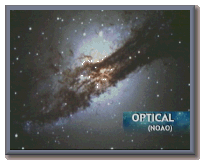
OPTICAL: |
This is one of the best optical images... |
|
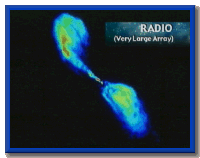
In radio light these jets shoot out from the galaxy a distance about 6 diameters of our milky way galaxy!!! |
RADIO: |
|
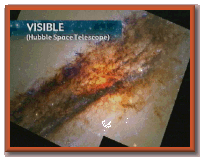
VISIBLE: |
This is what Hubble's powerful eye sees... a dark disk left over from what may have been a collision between an elliptical galaxy and a smaller spiral galaxy... |
NEAR INFRARED:
(HST: Near Infrared Camera and Multi-Object Spectrometer)
|
Zooming further in, even Hubble's eye gets blocked by all the gas and dust |
|
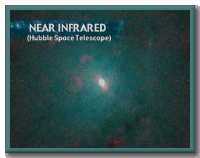
But using infrared light, Hubble can see through the dust to the hot gas researchers think is swirling around a black hole many millions of times more massive than our Sun!
|
"EINSTEIN" X-RAY OBSERVATORY (1979) |
Earlier, the "Einstein" X-ray Observatory had been able to see deep down, to where the energetic jets begin... |
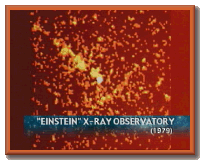
|
Now Chandra can resolve still finer details of this active galactic nucleus... |
|
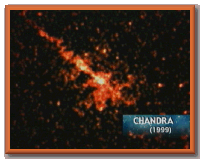
|
Electromagnetic Spectrum
Imagine the Universe
Electromagnetic Spectrum
Interactive Multimedia Adventures for Grade-school Education Using Remote Sensing (IMAGERS)
NASA's Observatorium
|
