|
Legacy of the International Heliophysical Year
Practical Applications and Fundamental Breakthroughs
|
IBEX
 NASA's IBEX website describes the purpose of this new satellite as follows: "What do you see when you look at the regions where the Sun's influence wanes and interstellar space begins? It depends on how you look. While many astronomers observe the wonders of the universe through the light that objects emit, some build an image using atomic particles instead. For the first time, space physicists are building a comprehensive picture of the interactions taking place in the outer solar system-called the interstellar boundary-using particles detected by NASA's Interstellar Boundary Explorer (IBEX). 'IBEX is a fantastic mission of exploration and discovery,' said David McComas, of the Southwest Research Institute in San Antonio, Texas, who is the principal investigator of the IBEX mission. The new satellite's mapping mission got under way in December 2007 when IBEX saw 'first light,' that moment when scientists anxiously point a telescope at its target for the first time and begin collecting photons, radio waves or, in IBEX's case, high-speed atoms. 'Like an optical or radio observatory, where the first 'on target' photons through the focal plane are called 'first light,' we now have the first energetic neutral atoms (ENAs) detected by IBEX's sensors,' said Robert MacDowall, IBEX mission scientist at NASA's Goddard Space Flight Center in Greenbelt, Md. For updated mission news, results, and blogs from the mission team, please Click Here for more info. NASA's IBEX website describes the purpose of this new satellite as follows: "What do you see when you look at the regions where the Sun's influence wanes and interstellar space begins? It depends on how you look. While many astronomers observe the wonders of the universe through the light that objects emit, some build an image using atomic particles instead. For the first time, space physicists are building a comprehensive picture of the interactions taking place in the outer solar system-called the interstellar boundary-using particles detected by NASA's Interstellar Boundary Explorer (IBEX). 'IBEX is a fantastic mission of exploration and discovery,' said David McComas, of the Southwest Research Institute in San Antonio, Texas, who is the principal investigator of the IBEX mission. The new satellite's mapping mission got under way in December 2007 when IBEX saw 'first light,' that moment when scientists anxiously point a telescope at its target for the first time and begin collecting photons, radio waves or, in IBEX's case, high-speed atoms. 'Like an optical or radio observatory, where the first 'on target' photons through the focal plane are called 'first light,' we now have the first energetic neutral atoms (ENAs) detected by IBEX's sensors,' said Robert MacDowall, IBEX mission scientist at NASA's Goddard Space Flight Center in Greenbelt, Md. For updated mission news, results, and blogs from the mission team, please Click Here for more info. |
 1989 1989
The HydroQuebec Blackout of March 1989 "On March 13, 1989, at 2:44 am, a transformer failure on one of the main power transmission lines in the HydroQuebec system precipitated a catastrophic collapse of the entire power grid. The string of events that produced the collapse took only 90 seconds from start to finish. There was no time for any meaningful intervention. The transformer failure was a direct consequence of ground-induced currents from a space weather disturbance high in the atmosphere. 6 million people lost electrical power for 9 or more hours. The space weather disturbance that produced this devastation was a great magnetic storm. Great magnetic storms are awesome disturbances in the near-Earth space environment that occur relatively rarely. The last five occurred in February 1986, March 1989, March 1991, November 1991 and May 1992. The frequency of large and great storms increases markedly as we enter the maximum in the solar activity cycle. Better warning of impending space weather events would allow power companies to take steps to reduce the load on sensitive circuits, delay maintenance and equipment replacement, prevent the development of large potential drops by selectively grounding sensitive devices and inteligently deal with systems designed to automatically protect the network during the duration of the event. This is the best way to prevent costly and dangerous black out situations triggered by space weather events."
For hands-on activities designed to help students understand blackouts and potential disruptions of satellites and other systems, please Click Here and Here.
Image credit: M. A. Shea, Geophysics Directorate, Phillips Laboratory |
1998
 Though initially mysterious and even controversial, researchers now describe the 1998 event as follows: "A very intense flux of electrons, evident in the magnetosphere earlier this year, may have caused a satellite failure (or at least exacerbated the situation) leading to the loss of telephone pager service to 45 million customers... The electrons, known as highly relativistic electrons (HREs), were especially numerous in the weeks preceding the failure. Researchers say HREs have triggered spacecraft anomalies in the past when fluxes are elevated. They therefore believe this energetic electron event could have been behind the failure of the attitude control system of the Galaxy 4 spacecraft at 2200 UT on May 19, 1998. A backup system also failed, either at the same time or earlier, so operators were unable to maintain a stable Earth link. Galaxy 4 is a heavily used communication satellite at geostationary orbit. Its sudden failure caused not only widespread loss of pager service but also numerous other communication outages. Using a wide array of datasets, our team of scientists analyzed the space environment for the times in question and found evidence of highly disturbed solar, solar wind, and geomagnetic conditions in late April and early May. The combination of coronal mass ejections, solar flares, and high speed solar wind streams led to a powerful sequence of interplanetary disturbances that hit the Earth. These disturbances produced a deep, powerful, and long-lasting enhancement of the HRE population throughout the outer Van Allen radiation zone …It will be most important to determine how well space systems can stand up to the multifaceted effects of the space environment over the next several years." Though initially mysterious and even controversial, researchers now describe the 1998 event as follows: "A very intense flux of electrons, evident in the magnetosphere earlier this year, may have caused a satellite failure (or at least exacerbated the situation) leading to the loss of telephone pager service to 45 million customers... The electrons, known as highly relativistic electrons (HREs), were especially numerous in the weeks preceding the failure. Researchers say HREs have triggered spacecraft anomalies in the past when fluxes are elevated. They therefore believe this energetic electron event could have been behind the failure of the attitude control system of the Galaxy 4 spacecraft at 2200 UT on May 19, 1998. A backup system also failed, either at the same time or earlier, so operators were unable to maintain a stable Earth link. Galaxy 4 is a heavily used communication satellite at geostationary orbit. Its sudden failure caused not only widespread loss of pager service but also numerous other communication outages. Using a wide array of datasets, our team of scientists analyzed the space environment for the times in question and found evidence of highly disturbed solar, solar wind, and geomagnetic conditions in late April and early May. The combination of coronal mass ejections, solar flares, and high speed solar wind streams led to a powerful sequence of interplanetary disturbances that hit the Earth. These disturbances produced a deep, powerful, and long-lasting enhancement of the HRE population throughout the outer Van Allen radiation zone …It will be most important to determine how well space systems can stand up to the multifaceted effects of the space environment over the next several years." |
Fusion
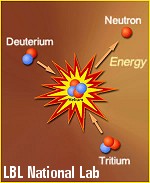 According to the US Department of Energy, "Fusion is the process that powers the Sun and the stars. In one type of this reaction, two atoms of hydrogen combine together, or fuse, to form an atom of helium. In the process some of the mass of the hydrogen is converted into energy. The easiest fusion reaction to make happen combines deuterium (or 'heavy hydrogen') with tritium (or 'heavy-heavy hydrogen') to make helium and a neutron. Deuterium is plentifully available in ordinary water. Tritium can be produced by combining the fusion neutron with the abundant light metal lithium. Thus fusion has the potential to be an inexhaustible source of energy. Hydrogen gas is typically heated to very high temperatures (100 million degrees or more) to give the atoms sufficient energy to fuse. In the process the gas becomes ionized, forming a plasma. If this plasma is held together (i.e. confined) long enough, then the sheer number of fusion reactions may produce more energy than what's required to heat the gas, generating excess energy that can be used for other applications. The Sun and stars do this with gravity. More practical approaches on Earth are magnetic confinement, where a strong magnetic field holds the ionized atoms together while they are heated by microwaves or other energy sources, and inertial confinement, where a tiny pellet of frozen hydrogen is compressed and heated by intense radiation, such as a laser beam, so quickly that fusion occurs before the atoms can fly apart. According to the US Department of Energy, "Fusion is the process that powers the Sun and the stars. In one type of this reaction, two atoms of hydrogen combine together, or fuse, to form an atom of helium. In the process some of the mass of the hydrogen is converted into energy. The easiest fusion reaction to make happen combines deuterium (or 'heavy hydrogen') with tritium (or 'heavy-heavy hydrogen') to make helium and a neutron. Deuterium is plentifully available in ordinary water. Tritium can be produced by combining the fusion neutron with the abundant light metal lithium. Thus fusion has the potential to be an inexhaustible source of energy. Hydrogen gas is typically heated to very high temperatures (100 million degrees or more) to give the atoms sufficient energy to fuse. In the process the gas becomes ionized, forming a plasma. If this plasma is held together (i.e. confined) long enough, then the sheer number of fusion reactions may produce more energy than what's required to heat the gas, generating excess energy that can be used for other applications. The Sun and stars do this with gravity. More practical approaches on Earth are magnetic confinement, where a strong magnetic field holds the ionized atoms together while they are heated by microwaves or other energy sources, and inertial confinement, where a tiny pellet of frozen hydrogen is compressed and heated by intense radiation, such as a laser beam, so quickly that fusion occurs before the atoms can fly apart.
Who cares? Scientists have sought to make fusion work on earth for over 50 years. If we are successful, we will have an energy source that is inexhaustible. One out of every 6,500 atoms of hydrogen in ordinary water is deuterium, giving a gallon of water the energy content of 300 gallons of gasoline. In addition, fusion would be environmentally friendly, producing no combustion products or greenhouse gases. While fusion is a nuclear process, the products of the fusion reaction (helium and a neutron) are not intrinsically radioactive. Short-lived radioactivity may result from interactions of the fusion products with the reactor walls, but with proper design a fusion power plant would be passively safe, and would produce no long-lived radioactive waste. Design studies show that electricity from fusion should eventually be about the same cost as present day sources." |
|