From Explorer 1 to the Voyagers
The first 50 years of the Space Age 
Van Allen
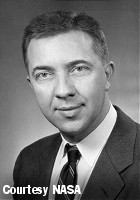 James Van Allen was a long-time professor of physics at the University of Iowa and left his name on the Van Allen radiation belts which his Explorer 1 satellite discovered in 1958, and his legacy in the dedicated space scientists he taught or inspired, such as Tom Krimigis who reminisces about the early days of the American space program in SUN TO STARS. For more, on the occasion of his death in 2006 at age 91, please Click Here and Here. James Van Allen was a long-time professor of physics at the University of Iowa and left his name on the Van Allen radiation belts which his Explorer 1 satellite discovered in 1958, and his legacy in the dedicated space scientists he taught or inspired, such as Tom Krimigis who reminisces about the early days of the American space program in SUN TO STARS. For more, on the occasion of his death in 2006 at age 91, please Click Here and Here.
The archival footage of Van Allen and his students appearing in FROM THE SUN TO THE STARS was provided by his alma mater, the University of Iowa and its Center for Media Production. A complete documentary about Dr. Van Allen, narrated by Tom Brokaw, is available by calling 800-369-4692 or online. |
 |
Sputnik
NASA assembled an excellent introduction to the birth of the Space Age on the occasion of the 50th anniversary of the 1957 launch of Sputnik by the then-Soviet Union. At this site you can listen to the first "beep-beep" sounds heard as Earth's first artificial satellite passed overhead, find hi-resolution images, in-depth historical documents, and much more. Roger Launius' article links the US response to the shock of Sputnik to the birth of NASA. |
Explorer 1
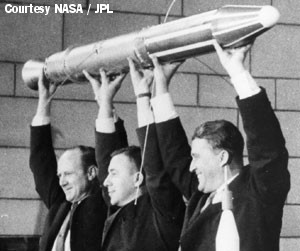 America's first satellite, as described in SUN TO STARS, was Explorer 1. NASA's JPL, which operated the satellite, offers images, videos, downloads, "Fast Facts" and history Here. "Explorer 1 was the first satellite launched by the United States when it was sent into space on January 31, 1958. Following the launch of the Soviet Union's Sputnik 1 on October 4, 1957, the U.S. Army Ballistic Missile Agency was directed to launch a satellite using its Jupiter C rocket developed under the direction of Dr. Wernher von Braun. The Jet Propulsion Laboratory received the assignment to design, build and operate the artificial satellite that would serve as the rocket's payload. JPL completed this job in less than three months." America's first satellite, as described in SUN TO STARS, was Explorer 1. NASA's JPL, which operated the satellite, offers images, videos, downloads, "Fast Facts" and history Here. "Explorer 1 was the first satellite launched by the United States when it was sent into space on January 31, 1958. Following the launch of the Soviet Union's Sputnik 1 on October 4, 1957, the U.S. Army Ballistic Missile Agency was directed to launch a satellite using its Jupiter C rocket developed under the direction of Dr. Wernher von Braun. The Jet Propulsion Laboratory received the assignment to design, build and operate the artificial satellite that would serve as the rocket's payload. JPL completed this job in less than three months." |
 |
Voyager
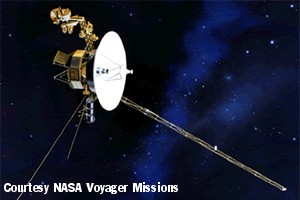
"The twin Voyager spacecraft, launched in 1977 to travel to and explore Jupiter, Saturn, Uranus and Neptune, have made many intriguing discoveries, including a possible ocean of liquid water on one of Jupiter's moons." For the full story of the mission, Click Here. Be sure to check out the "Voyager Record," the ambitious effort led by popular astronomer Carl Sagan and friends to place the most characteristic images, sounds and music on board what would become an interstellar spacecraft so that any alien species which might one day intercept the mission might know something about life on distant Earth. The Voyagers' images of Jupiter, Saturn, Uranus and Neptune are also not to be missed. |
Heliopause
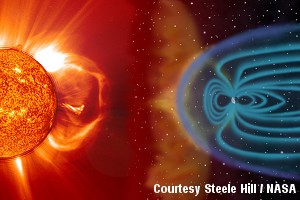 For useful definitions of unfamiliar terms such as "heliopause", "heliosphere", and more, check out the "Windows to the Universe" website which usefully offers information geared to "Beginner", "Intermediate" and "Advanced" audiences. Here's their context for heliopause: " 'Helios' is the ancient Greek word for the 'sun'. The Heliosphere is the entire region of space influenced by the sun. That would include the regions of space which contain the IMF (Interplanetary Magnetic Field.) The magnetic field of the sun (the IMF) is enormous and is carried throughout space by the solar wind. The solar wind and the IMF push back the Interstellar magnetic field (ISM) and plasma of interstellar space. They create a bubble or cavity, within which the sun and planets reside. The boundary between space dominated by the sun and interstellar space is called the heliopause. No one knows just how far away the heliopause, or "edge" of the heliosphere is, but it could be as far away as 100 AU." But check out the Voyager website, referenced above, for the continuing exploration of this little-known region of our solar system. For useful definitions of unfamiliar terms such as "heliopause", "heliosphere", and more, check out the "Windows to the Universe" website which usefully offers information geared to "Beginner", "Intermediate" and "Advanced" audiences. Here's their context for heliopause: " 'Helios' is the ancient Greek word for the 'sun'. The Heliosphere is the entire region of space influenced by the sun. That would include the regions of space which contain the IMF (Interplanetary Magnetic Field.) The magnetic field of the sun (the IMF) is enormous and is carried throughout space by the solar wind. The solar wind and the IMF push back the Interstellar magnetic field (ISM) and plasma of interstellar space. They create a bubble or cavity, within which the sun and planets reside. The boundary between space dominated by the sun and interstellar space is called the heliopause. No one knows just how far away the heliopause, or "edge" of the heliosphere is, but it could be as far away as 100 AU." But check out the Voyager website, referenced above, for the continuing exploration of this little-known region of our solar system. |
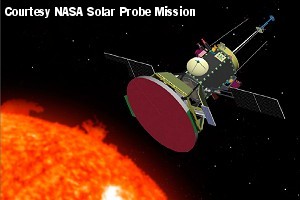 Solar Probe Plus Solar Probe Plus
This mission, which Tom Krimigis describes on camera, will be one of NASA's most ambitious: "Solar Probe Plus will be an extraordinary and historic mission, exploring what is arguably the last region of the solar system to be visited by a spacecraft, the Sun's outer atmosphere or corona as it extends out into space. Solar Probe Plus will repeatedly sample the near-Sun environment, revolutionizing our knowledge and understanding of coronal heating and of the origin and evolution of the solar wind and answering critical questions in heliophysics that have been ranked as top priorities for decades. Moreover, by making direct, in-situ measurements of the region where some of the most hazardous solar energetic particles are energized, Solar Probe Plus will make a fundamental contribution to our ability to characterize and forecast the radiation environment in which future space explorers will work and live." Click Here for more information. |
|
|