Science Years and "Experiments In Concert"
In Search of Causes of the Aurora… Then and Now 
THEMIS
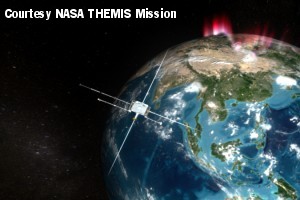 "NASA's 'Time History of Events and Macroscale Interactions during Substorms' mission (THEMIS, for short!) aims to resolve one of the oldest mysteries in space physics, namely to determine what physical process in near-Earth space initiates the violent eruptions of the aurora that occur during substorms in the Earth's magnetosphere. THEMIS is a 2-year mission launched in 2007 consisting of 5 identical probes that will study the violent colorful eruptions of auroras. "NASA's 'Time History of Events and Macroscale Interactions during Substorms' mission (THEMIS, for short!) aims to resolve one of the oldest mysteries in space physics, namely to determine what physical process in near-Earth space initiates the violent eruptions of the aurora that occur during substorms in the Earth's magnetosphere. THEMIS is a 2-year mission launched in 2007 consisting of 5 identical probes that will study the violent colorful eruptions of auroras.
Understanding and predicting space weather is important to describe the environment in which spacecraft and astronauts operate and ensure their safety. Just as hail and tornadoes accompany the most severe thunderstorms, substorms accompany the most intense space storms - those that disrupt communications, cause power line transmission failures, and produce the most penetrating radiation. THEMIS will study substorms to gain insight into the most severe space storms." For more, please Click Here |
 |
IPY 1
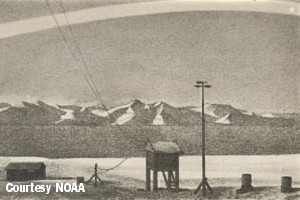
NOAA's Arctic Research Office has created an excellent resource describing the science campaigns associated with the first International Polar Year of 1881-1884 (yes, the name is singular but the years were multiple!), including images, science data, and much more. "The records of the first International Polar Year (IPY) offer a unique opportunity to study the Arctic as it existed prior to the present era of environmental change. Meteorological data from IPY stations have been collected and are presented here for the first time in digital format. An extensive documentary image collection may also be viewed." There are descriptions of Karl Weyprecht, IPY's founding father - who tragically died in 1881 and did not live to see the fruits of his vision - and of scientific activities at observatories all around the Arctic. It's very well worth a visit! |
IGY (International Geophysical Year) 1957-1958
One of the very best sources for information about the IGY is the National Academy of Sciences.
 "Following a suggestion by NAS member Lloyd Berkner, the International Council of Scientific Unions in 1952 proposed a comprehensive series of global geophysical activities to span the period July 1957-December 1958. The International Geophysical Year (IGY), as it was called, was modeled on the International Polar Years of 1882-1883 and 1932-1933 and was intended to allow scientists from around the world to take part in a series of coordinated observations of various geophysical phenomena." "IGY activities literally spanned the globe from the North to the South Poles. Although much work was carried out in the Arctic and equatorial regions, special attention was given to the Antarctic, where research on ice depths yielded radically new estimates of the Earth's total ice content. IGY Antarctic research also contributed to improved meteorological prediction, advances in the theoretical analysis of glaciers, and better understanding of seismological phenomena in the Southern Hemisphere. Given the state of science in the late 1950s, the timing of the IGY was highly opportune. Research technologies and tools had advanced greatly since the 1930s, allowing scientists a scope of investigation without precedent. Cosmic ray recorders, spectroscopes, and radiosonde balloons had opened the upper atmosphere to detailed exploration, while newly developed electronic computers facilitated the analysis of large data sets. But the most dramatic of the new technologies available to the IGY was the rocket. (As seen in the following section of the SUN TO STARS program: the editors) Post-World War II developments in rocketry for the first time made the exploration of space a real possibility; working with the new technologies, Soviet and American participants sent artificial satellites into earth orbit. In successfully launching science into space, the IGY may have scored its greatest breakthrough. "Following a suggestion by NAS member Lloyd Berkner, the International Council of Scientific Unions in 1952 proposed a comprehensive series of global geophysical activities to span the period July 1957-December 1958. The International Geophysical Year (IGY), as it was called, was modeled on the International Polar Years of 1882-1883 and 1932-1933 and was intended to allow scientists from around the world to take part in a series of coordinated observations of various geophysical phenomena." "IGY activities literally spanned the globe from the North to the South Poles. Although much work was carried out in the Arctic and equatorial regions, special attention was given to the Antarctic, where research on ice depths yielded radically new estimates of the Earth's total ice content. IGY Antarctic research also contributed to improved meteorological prediction, advances in the theoretical analysis of glaciers, and better understanding of seismological phenomena in the Southern Hemisphere. Given the state of science in the late 1950s, the timing of the IGY was highly opportune. Research technologies and tools had advanced greatly since the 1930s, allowing scientists a scope of investigation without precedent. Cosmic ray recorders, spectroscopes, and radiosonde balloons had opened the upper atmosphere to detailed exploration, while newly developed electronic computers facilitated the analysis of large data sets. But the most dramatic of the new technologies available to the IGY was the rocket. (As seen in the following section of the SUN TO STARS program: the editors) Post-World War II developments in rocketry for the first time made the exploration of space a real possibility; working with the new technologies, Soviet and American participants sent artificial satellites into earth orbit. In successfully launching science into space, the IGY may have scored its greatest breakthrough.
Overall, the IGY was highly successful in achieving its goals, which were summed up in an NAS IGY Program Report: '...to observe geophysical phenomena and to secure data from all parts of the world; to conduct this effort on a coordinated basis by fields, and in space and time, so that results could be collated in a meaningful manner.'" |
 Syun-Ichi Akasofu Syun-Ichi Akasofu
Dr. Syun-Ichi Akasofu, IARC Founding Director and Professor of Physics, Emeritus, was the director of the International Arctic Research Center of the University of Alaska Fairbanks from its establishment in 1998 until January of 2007. He originally came to the University of Alaska Fairbanks (UAF) in 1958 as a graduate student to study the aurora under Sydney Chapman, receiving his PhD in 1961. He has been professor of geophysics since 1964. Dr. Akasofu's auroral work has earned national and international recognition. His paper on the aurora published in 1964 was cited as one of the most quoted papers. Upon his retirement in 2007, the University of Alaska Board of Regents officially named the building that houses the International Arctic Research Center the "Syun-Ichi Akasofu Building" in recognition of "his tireless vision and dedicated service to the university, the state, and country in advancing arctic science." |
Reconnection
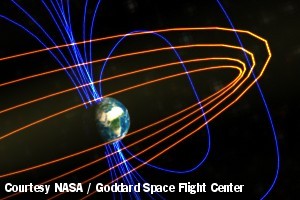
Members of the THEMIS science team describe magnetic reconnection in this way: "a common process that occurs throughout the Universe when stressed magnetic field lines suddenly 'snap' to a new shape, like a rubber band that's been stretched too far." As project scientist David Sibeck explains in the SUN TO STARS program, "As they capture and store energy from the solar wind, the Earth's magnetic field lines stretch far out into space. Magnetic reconnection releases the energy stored within these stretched magnetic field lines, flinging charged particles back toward the Earth's atmosphere. They create halos of shimmering aurora circling the northern and southern poles." For more information, and for links to some excellent NASA animations available in larger or smaller video clips, Click Here |
 |
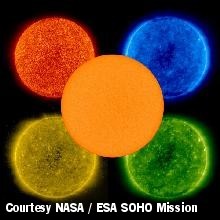 Heliospheric "Great Observatory" Heliospheric "Great Observatory"
The Heliospheric "Great Observatory" is a virtual one, made up of individual US and international missions distributed across the solar system, from SOHO and others at L1 (the Lagrange point at which the gravity of the Sun and Earth more or less balance out to keep spacecraft "on station") to those closer to Earth (Cluster, Polar, Geotail, THEMIS, see above) and others already at the edge of the solar system (the Twin Voyagers) and NEW HORIZONS, en route to Pluto. Some of these spacecraft will undoubtedly fall silent as consumables are used up, or accidents happen, but many are longer-lived than originally anticipated, like Ulysses which was the first spacecraft to fly over the poles of the Sun. |
|
|