Space Weather & Global Society
Blowing in the Solar Wind 
IHY
 IHY, or the "International Heliophysical Year," has been a two year initiative building on the legacy of previous science years, and integrating advances in understanding of the Sun and the solar system made in the first 50 years of the Space Age. In the words of the IHY Vision statement (http://ihy2007.org/about/vision.shtml) IHY, or the "International Heliophysical Year," has been a two year initiative building on the legacy of previous science years, and integrating advances in understanding of the Sun and the solar system made in the first 50 years of the Space Age. In the words of the IHY Vision statement (http://ihy2007.org/about/vision.shtml)
2007 marked the 50th Anniversary of the International Geophysical Year (IGY) and 50 years of space exploration, which began with the launch of Sputnik by the Soviet Union (1957) and Explorer 1 by the United States (1958.) Today NASA and international partners have created an extensive suite of spacecraft and observatories, a distributed "Great Observatory," which places humanity on the verge of a system-wide understanding of the entire interconnected heliophysical system. The term "heliophysical" is an extension of the term "geophysical," where the Earth, Sun & Solar System are studied not as separate domains but through the universal processes governing the entire system. As we approach the limit of human exploration (with spacecraft like Voyager 1 and 2 approaching the edge of the solar system) and prepare for humanity's first encounter with interstellar space, we have expanded our concept of "geophysics" to embrace other planets, interplanetary space, and the Sun itself.
IHY has had three primary objectives: (1) Advancing our understanding of the fundamental heliophysical processes that govern the Sun, Earth and heliosphere; (2) Continuing the tradition of international research and advancing the legacy on the 50th anniversary of the International Geophysical Year; (3) Demonstrating the beauty, relevance and significance of space and Earth science to the world. |
 |
Solar Wind
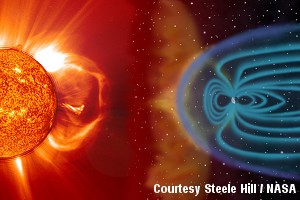
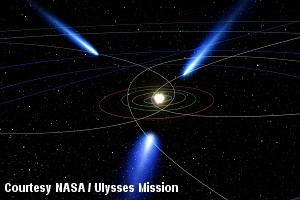
The solar wind is the plasma of charged particles (protons, electrons, and heavier ionized atoms) coming out of the Sun in all directions at very high speeds - an average of about 400 km/sec, almost a million mph! (Cosmicopia, http://helios.gsfc.nasa.gov/sw.html) Its constant pressure is responsible for the tails of comets always pointing away from the Sun, (left), and the shape of the magnetic fields around the planets. (See Magnetosphere.) The solar wind can also have a measurable effect on the flight paths of spacecraft. The solar wind varies routinely through the 27-day rotation of the Sun, as well as sporadically in response to violent eruptions in the corona. These eruptions can result in geomagnetic storms on Earth. |
Space Weather
 According to the SOHO website (the SOlar and Heliospheric Observatory spacecraft, operated by NASA and ESA, http://sohowww.nascom.nasa.gov/spaceweather/) "space weather" can be defined as "Conditions on the Sun and in the solar wind, magnetosphere, ionosphere and thermosphere that can influence the performance and reliability of space-borne and ground-based technological systems and can endanger human life or health." According to the SOHO website (the SOlar and Heliospheric Observatory spacecraft, operated by NASA and ESA, http://sohowww.nascom.nasa.gov/spaceweather/) "space weather" can be defined as "Conditions on the Sun and in the solar wind, magnetosphere, ionosphere and thermosphere that can influence the performance and reliability of space-borne and ground-based technological systems and can endanger human life or health."
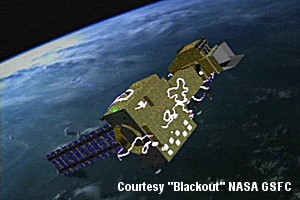
Space weather happens when a solar storm from the Sun travels through space and impacts the Earth's magnetosphere. Studying space weather is important to the national economy because solar storms can affect the advanced technology we have become so dependent upon in our everyday lives. (See "1989" and "1998" in "Legacy of the IHY") Energy and radiation from solar flares and coronal mass ejections can: (1) Harm astronauts in space; (2) Damage sensitive electronics on orbiting spacecraft; (3) Cause colorful auroras, often seen in the higher latitudes, and (4) Create blackouts on Earth when they cause surges in power grids. Understanding the changing Sun and its effects on the solar system, life, and society is the main goal of NASA's Sun-Earth Connection theme. Many NASA missions focus on the Sun and its interactions with Earth. Current missions include SOHO, ACE, IMAGE, SORCE, STEREO and Cluster. Future missions include the Solar Dynamics Observatory and Solar Probe Plus.
For an excellent and constantly updated overview of space weather events (auroras, comet sightings, and more) check out: http://spaceweather.com/ |
 |
Aurora
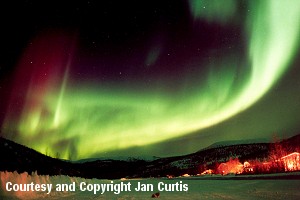
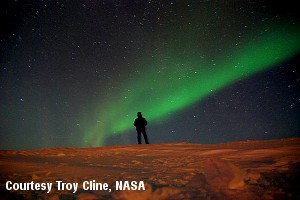
"If you are standing in Alaska, Canada, or the Northern United States on a clear dark night and looking up into the sky, you may see a bright greenish-white band of light that stretches across the sky from the East to the West. You are seeing the Northern Lights, also known as the Aurora Borealis. These types of lights also occur near the South Pole, where they are known as the Southern Lights and Aurora Australis." NASA's THEMIS mission hosts an excellent introduction to the aurora, with links to both spacecraft missions and surface photographs. (http://www.nasa.gov/mission_pages/themis/auroras/aurora_feature2.html)
Many of the aurora images seen in SUN TO STARS have been licensed from Jan Curtis, whose extensive collection of aurora images is one of the very best. Feel free to visit and browse, but note that these pictures are covered by copyright: http://climate.gi.alaska.edu/Curtis/curtis.html |
 Polar Gateways Arctic Circle Sunrise 2008 Polar Gateways Arctic Circle Sunrise 2008
The ICESTAR/IHY team for the International Polar and Heliophysical Years 2007-2009 convened the "Polar Gateways Arctic Circle Sunrise 2008" conference at Barrow, Alaska, the northernmost town of the United States, during the first week of local polar sunrise, January 23-29, 2008, to address Earth, planetary, and heliophysical science and future exploration of polar and icy worlds in the solar system. (http://polargateways2008.gsfc.nasa.gov/)
According to the official conference website, in the words of T. S. Eliot we found that "the end of all our exploring will be to arrive where we started" with a new appreciation for connections of science of the Sun, the Earth, the other planetary bodies, and the heliosphere from these different disciplines. In visiting Barrow, accessible at this time only by air travel and otherwise isolated in all directions by icy tundra or ocean, all on-site participants gained a true sense of what life would be like in pioneering communities on other worlds. Videoconference and teleconference technology allowed us to extend two-way participation in the science sessions to ICESTAR/IHY team scientists gathered at other Arctic sites in Norway, Sweden, and Russia, also to Antarctica, and to a larger group of scientists at two NASA Centers and three universities in the U.S.
See also the mini-series of three SUN TO STARS podcasts accessible at: http://suntostars.info/ss01.php |
|
|